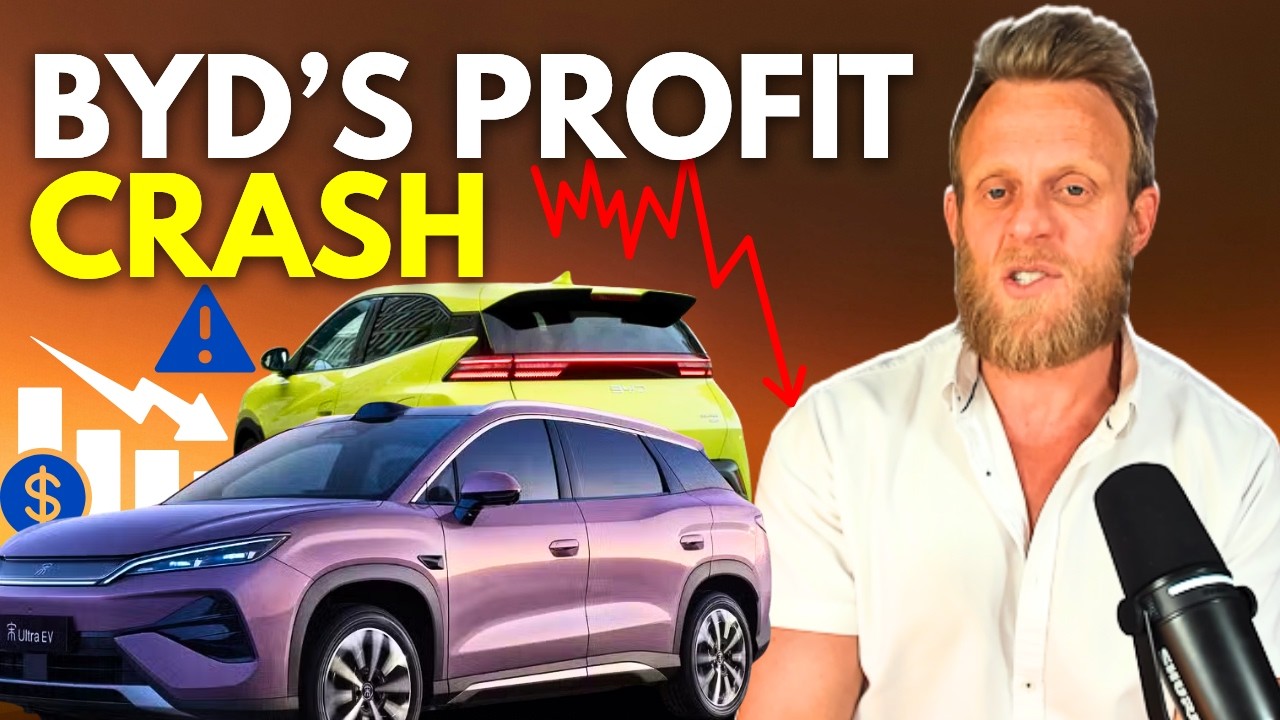
BYD reported its sharpest profit drop in six years on Tuesday, with first-quarter 2026 net profit falling 55% to 4.1 billion yuan, around US$594 million, as China's biggest electric vehicle maker felt the combined weight of a demand pull-forward and a domestic price war.
Revenue was down roughly 12% year-over-year. New energy vehicle sales, BYD's combined plug-in hybrid and battery-electric volume, came in at 700,460 units for the quarter, down 30% versus the same quarter last year and almost 48% lower than the December quarter that closed 2025.
On paper, the headline looks like a collapse. The Electric Viking, in a 1 May breakdown of the print, argued the more useful frame is a market reset rather than a BYD-specific failure.

"This isn't really just a BYD collapse, it's a China EV market reset," the channel said. "And it tells us something very important about where the entire EV industry is heading."
The immediate driver is policy. Through 2024 and 2025, Beijing exempted new energy vehicles from purchase tax up to a maximum of 30,000 yuan per vehicle, a discount worth roughly US$4,400 to the buyer. From 2026 the cap was halved to about 15,000 yuan, or US$2,200. With the cliff edge known months in advance, Chinese consumers pulled spending forward into November and December, leaving Q1 emptied out.
Nio chief executive William Li had warned about exactly this dynamic last year. "Once national support policies were reduced, the entire Chinese EV industry would face pressure in the first quarter," Li said at the time. The Q1 print across the listed Chinese OEMs has now confirmed that call.
The second pressure point is structural. China is running the most competitive car market in history, with too many brands chasing the same domestic buyers. As the largest player, BYD has more pricing power than anyone else in the field, but even BYD has been forced to defend market share with price cuts that compress per-unit margin.

The Electric Viking's read on the read-through to legacy original equipment manufacturers is sobering. "If BYD, the cost-control king, is seeing profit fall more than half, imagine what this kind of pricing pressure does to Volkswagen, Toyota, Nissan, Honda, Ford, General Motors, and Stellantis," the channel said. None of those manufacturers carry BYD's vertical integration, blade-battery supply chain, or scale.
BYD's longer thesis has not changed. The company still owns its motors, electronics, and battery cell production, and is on track to ship more than 1.3 million vehicles into export markets this year, with Australia, Brazil, Thailand, and the United Kingdom as the largest non-China contributors.
For investors, the practical question is whether the second-half ramp materialises as the pull-forward unwinds and exports compound. The bear case is that price discipline does not return to the Chinese market until weaker brands fail and consolidate, a process that historically takes longer than equity markets are willing to wait through. The bull case is that BYD is the player most likely to be standing when it does.